Children's Jeans Sizing: Fit Guide for UK Parents
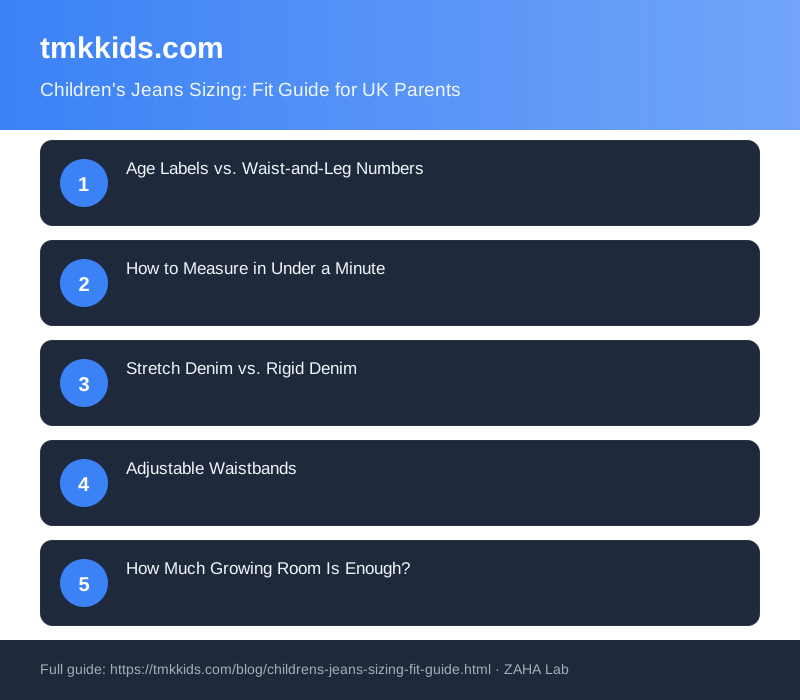
One in three parents picks up the wrong jeans size for their child at least twice a year. The fix takes under a minute.
Children's jeans in the UK use two labelling systems: age or actual waist and inside-leg measurements. Always measure your child directly. A size "6Y" can vary by 3 centimetres between brands.
This article contains affiliate links. TMK Kids earns a small commission on qualifying purchases at no extra cost to you.
Age Labels vs. Waist-and-Leg Numbers
Most high-street brands, including Next and Marks & Spencer, now print both systems on the label: "5-6Y / W48cm / L46cm". Budget lines and some supermarket own-brands show age only. That is where the confusion starts. A "6Y" in Zara fits differently to a "6Y" in H&M because each brand sets its own internal measurements. If a label shows age only, go to the brand's size chart and convert to centimetres before you buy.
How to Measure in Under a Minute
You need a soft tape measure. Have the child stand upright and relaxed.
For the waist, wrap the tape around the natural waist, just above the belly button. Do not pull it tight. Note the measurement in centimetres. For the inside leg, measure from the crotch seam straight down to the ankle bone. Write both numbers down before opening any website or walking into a shop.
Once you have the measurements, putting together everyday outfits is straightforward. A pack of Fruit of the Loom kids' T-shirts covers the basics and washes reliably week after week.
Stretch Denim vs. Rigid Denim
Stretch denim, usually labelled as containing 1-5% elastane, runs about one size smaller than stated because the fabric recovers after washing. If your child measures W52cm and the jeans are stretch, go up to W54. Rigid denim stays true to its stated size but restricts movement, so active children often find it uncomfortable within a few hours. Check the fabric composition on the label before choosing.
Adjustable Waistbands
Most children's jeans up to age 10-11 include an internal elasticated waistband secured by two buttons, covering roughly 4cm of adjustment. This is worth checking when a child sits between two sizes. Next and Marks & Spencer apply this system consistently across their ranges. If you are building a full outfit for school days, Amazon Essentials boys' school polo shirts follow the same size logic and pair well with straight-leg jeans for relaxed days.
How Much Growing Room Is Enough?
One size up gives roughly 2-3cm in the waist and 1.5-2cm on the inside leg. That covers around six to nine months of average growth. Two sizes up causes bunching at the crotch, which is uncomfortable and looks wrong. Hem the leg length if needed rather than going up beyond one size. The same principle applies when buying children's clothes multipacks: one size ahead is sensible, two is too far.
FAQ
What size jeans should a 5-year-old wear in the UK?
Most 5-year-olds measure around W50-52cm and inside leg 42-44cm. Those centimetre figures are more reliable than the age label alone, as a "5Y" can vary by up to 3cm between brands.
Do children's jeans shrink after washing?
Pure cotton denim can shrink 2-5% in the first wash at 40°C or above. Wash new jeans once before the child wears them, then assess the fit from there. Stretch denim with elastane shrinks less but still benefits from that first wash.
What does W48 mean on children's jeans?
W48 means the waist measurement is 48 centimetres. L followed by a number, for example L46, gives the inside-leg length in centimetres. Using both figures gives a far more accurate fit than the age label on its own.
How do I know if jeans are too tight in the waist?
If the waistband leaves a red mark after an hour of wear, they are too tight. A quick check: the child should be able to fit two fingers flat inside the waistband when the jeans are fastened and they are standing normally.
Are Next and H&M children's jeans the same sizing?
No. Next tends to cut slightly longer in the leg, while H&M often runs narrower in the waist. Always check the centimetre measurements on each brand's size chart rather than transferring sizes directly between brands.