Kids' School Trousers: Fit, Fabric and What Lasts
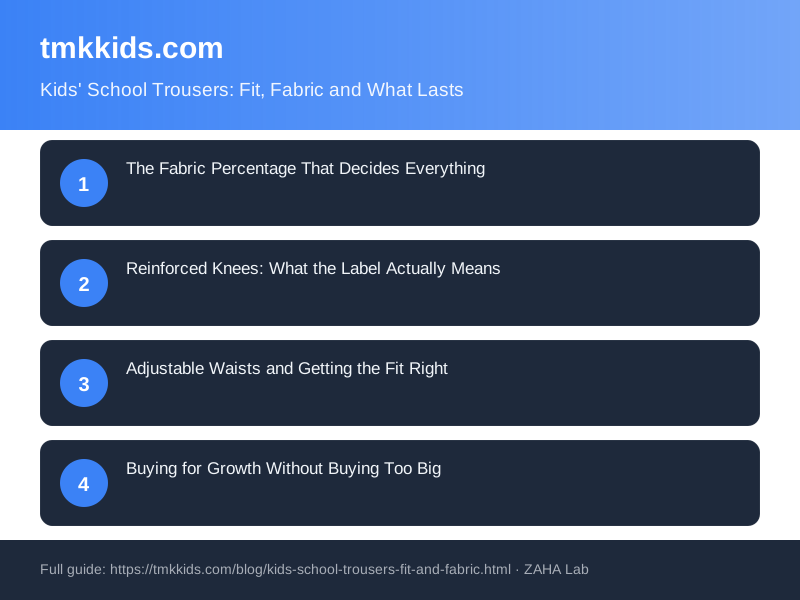
Most school trousers split at the knee before Christmas. The brand on the label rarely matters; the numbers on the care tag do.
The Fabric Percentage That Decides Everything
Children drag their knees on tarmac every break time and spend 45-minute lessons half off their chairs. A trouser fabric with less than 60% polyester absorbs the friction and wears through fast. The sweet spot is 65% polyester / 35% viscose, sometimes labelled 65/35 poly-viscose on the swing ticket. This mix resists pilling, holds its shape through 40°C machine washes, and dries overnight on a radiator.
Pure cotton school trousers look better on day one and start sagging by week three. Unlined 100% polyester can feel sticky against skin in warmer months. The poly-viscose blend handles both problems.
Dedicated uniform brands like Trutex flat-front school trousers print the fabric composition clearly on the swing ticket. Always check before buying, particularly with supermarket own-brand ranges where the composition can shift from season to season.
Reinforced Knees: What the Label Actually Means
"Reinforced knees" on packaging means one of two things: a double-layer panel sewn into the knee area, or a heavier denier fabric used throughout. The double-layer version lasts significantly longer. You can test it in the shop by squeezing the knee area, which should feel noticeably thicker than the thigh section. If it feels uniform throughout, the "reinforcement" is just marketing.
A pair with genuine double-layer knee panels, such as these boys' school trousers with reinforced knees, typically adds 2 to 3 months of usable life at the same price as a standard pair. Over a 3-child household, that difference compounds fast.
Adjustable Waists and Getting the Fit Right
An adjustable elasticated waist is not optional at primary school age. Children's waist measurements at age 7 vary by up to 10 cm within a single age bracket. A "7 to 8 years" trouser without waist adjustment means guessing, and guessing wrong produces a pair that falls down before lunch or cuts in by half-term.
Measure the natural waist just above the hip bone and add 2 cm. Then check the inside leg measurement against the brand's size chart rather than relying on the age label alone. If the child sits between two sizes, take the longer leg and use the waist adjuster to bring in the fit. Most school trousers come in slim, regular, and plus fits. Schools specify colour only, so choose the fit that matches the actual body shape.
Buying for Growth Without Buying Too Big
One size up works for roughly 6 months, not 12. A 2 cm excess at the waist adjusted inward is fine. Trouser legs turned up 4 cm create a trip hazard and look sloppy from 10 metres away. If buying ahead, stick to one size up and plan for a mid-year replacement. Buying two sizes up and hoping for growth rarely ends well.
Wash new school trousers once before the first wear. Poly-viscose blends shrink fractionally on the first wash. Better to find that out at home on a Sunday evening than at the school gate on Monday morning.
FAQ
What fabric is best for kids' school trousers?
A 65% polyester / 35% viscose mix is the most practical choice for everyday wear. It resists knee abrasion, washes well at 40°C, and dries quickly. Pure cotton looks smarter initially but degrades faster under daily playground conditions.
How do I measure my child for school trousers?
Measure the natural waist (just above the hip bone) and the inside leg from crotch to ankle bone. Add 2 cm to each measurement for comfort. Cross-reference both figures against the brand's own size chart rather than the age label, as sizing varies considerably between manufacturers.
Are reinforced knees worth paying extra for?
Yes, provided the reinforcement is a genuine double-layer panel and not just a label claim. Pinch the knee area in the shop to check. The price difference is usually under £2 per pair, and the gain in lifespan is consistently measurable.
Can kids' school trousers go in a tumble dryer?
Most poly-viscose school trousers tolerate a low-heat tumble cycle, but check the care label first. High heat degrades the elasticated waistband over time. Line drying or a cool radiator is safer and the trousers are usually dry within a few hours.
What age do children stop needing adjustable waist trousers?
Most children benefit from adjustable waists up to around age 11 or 12, when body proportions become more predictable. Many secondary school trousers drop the feature, but for primary school age it makes a practical difference every single week.
Related Products
Affiliate disclosure: some links on this page are affiliate links. TMK Kids may earn a small commission if you buy via these links, at no extra cost to you. This does not affect which products are featured or how they are described.