Kids T-Shirt Sizing Guide: Get the Fit Right
Disclosure: This post contains affiliate links. TMK Kids earns a small commission on qualifying purchases at no extra cost to you.
Chest measurements vary by up to 2cm across brands at the same stated age, so a "7-8 years" t-shirt from one maker can fit like a "9-10" from another. Nearly half of all children's clothing returns in the UK cite sizing as the reason.
The short answer: To size kids' t-shirts correctly, measure the chest (under the arms, across the widest point) and match it against that brand's own size chart. The age on the label is a starting point, not a rule.
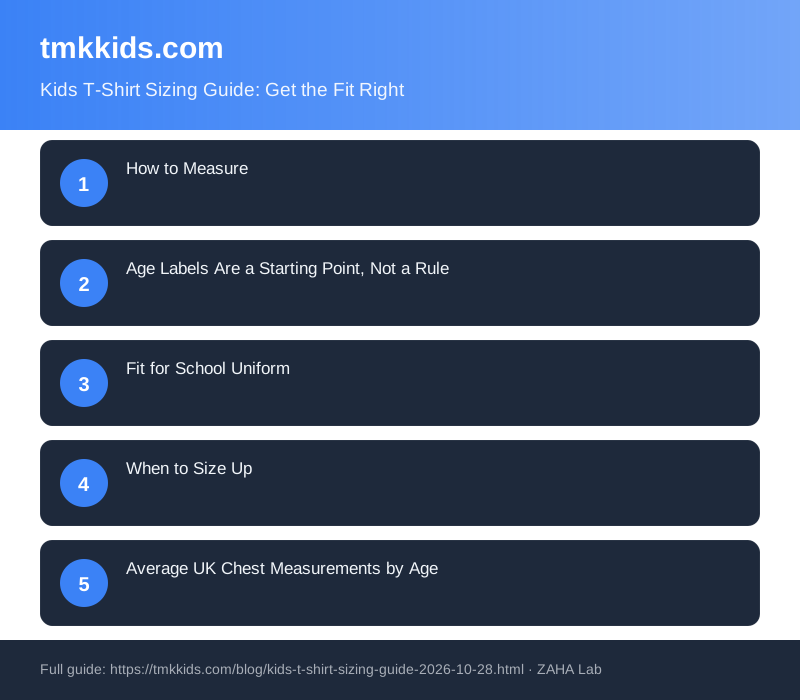
How to Measure
You need a soft tape measure. Stand your child upright, arms relaxed. Wrap the tape around the widest part of the chest, just below the armpits. Keep it snug. Write the number down.
For standard t-shirts, add 4-6cm to that chest measurement for a comfortable fit. Go to 8-10cm if your child wears a vest underneath or simply prefers a looser feel.
Age Labels Are a Starting Point, Not a Rule
Retailers build size charts around different growth references. Marks & Spencer tends to run slightly wider than many European brands. Budget multipacks such as the Fruit of the Loom Kids Value Weight T-Shirt often size generously, making them a safe buy at the stated age.
Height matters too. A tall, slim child may need a 9-10 for sleeve length but a 7-8 for chest width. When the two measurements fall into different brackets, prioritise chest for t-shirts. Sleeves that are slightly long look fine; a tight chest is uncomfortable all day long.
Fit for School Uniform
School polo shirts and PE tees need more room than weekend wear. Children tuck them in, sit at desks for hours, and do PE in them. Aim for at least 6cm of ease over the measured chest. The Amazon Essentials Boys' School Uniform Polo Shirt comes in a classic, generous block that holds up well across a full term.
Wash before the first day. Most cotton tees shrink 3-5% after the first wash, even those labelled pre-shrunk. If the measurement sits right on a size boundary, go up.
When to Size Up
For any t-shirt that needs to last a full school year, buy one size above the measured fit. Children gain an average of 6-7cm in height between September and the following July. A tee that fits in September is often tight by Easter. Multipacks spread both wear and cost per wash, so two or three sizes in a pack is a practical buy for primary-age children.
The one exception is sports performance wear. Those tees are cut close to the body by design. Size up by one full size compared to your usual casual pick.
Average UK Chest Measurements by Age
These figures come from the NHS child growth charts. Individual children vary, so always measure before ordering.
- Age 3-4: chest 53-55cm
- Age 5-6: chest 56-58cm
- Age 7-8: chest 60-62cm
- Age 9-10: chest 64-66cm
- Age 11-12: chest 68-72cm
Related Products
FAQ
What chest size is a kids' "age 7-8" t-shirt?
An age 7-8 label typically covers a chest of 60-62cm, based on average UK growth data. Because children grow at different rates, always compare your child's measured chest against the specific brand's chart rather than assuming the age label is accurate.
Should I size up when buying kids' t-shirts?
For school uniform, yes: go up one full size from the measured fit so the tee lasts the year. For casual weekend wear, the measured size works well unless your child is between two sizes, in which case go up.
Do kids' t-shirts shrink after washing?
100% cotton tees typically shrink 3-5% on the first wash. Washing at 30°C and tumble drying on low reduces this. Blended fabrics (cotton-polyester) shrink noticeably less and are worth considering for school wear.
How do I measure my child for a t-shirt?
Wrap a soft tape measure around the widest part of the chest, just below the armpits, keeping it horizontal and snug without pulling tight. Compare that figure to the brand's own size chart; do not rely on a generic age-to-size table.
Are UK kids' clothes sizes the same as EU sizes?
No. UK sizing typically uses age ranges such as "5-6 years," while EU sizing uses height in centimetres, for example "116cm." The 116cm EU size corresponds roughly to a UK 5-6 years, but chest width still varies by brand, so check both the height and chest columns on any size chart before ordering.