Kids' Winter Coats: How to Size and Buy Right
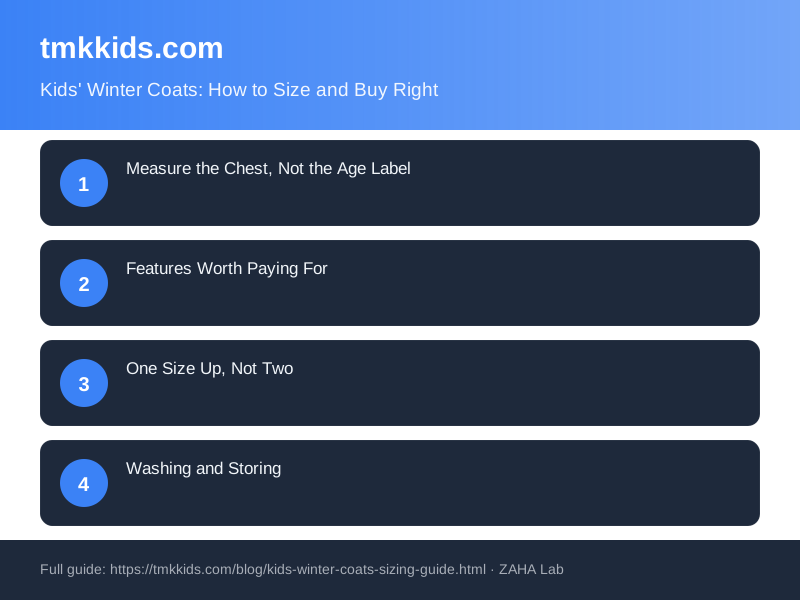
Most parents buy their child's winter coat two sizes too big. By February, the shoulder seams sit halfway down the arms and the zip is too fiddly for a five-year-old to manage on their own.
When sizing a kids' winter coat, go one size up from the current fit, not two. The shoulder seam must land at the actual shoulder. A coat that fits there traps heat properly and leaves arms free enough for a rucksack.
Disclosure: some links on this page are affiliate links. TMK Kids may earn a small commission at no extra cost to you.
Measure the Chest, Not the Age Label
Age labels shift by up to 4 cm between brands at the same size. Measure around the fullest part of your child's chest, over a school jumper or light fleece (since that's what will sit underneath the coat). Add 6 to 8 cm for movement. A child with a 64 cm chest, wearing a sweatshirt, needs a coat sized for 70 to 72 cm.
Height matters too, particularly for sleeve coverage. Cross-reference both chest and height against the brand's own size chart. For most padded kids' coats, the difference between a 5-6 age label and a 7-8 is roughly 6 cm in height and 4 cm in chest measurement.
Features Worth Paying For
Waterproof ratings are listed in millimetres on the swing tag. A 1,500 mm rating handles typical UK drizzle. Anything above 3,000 mm copes with a full wet school day outdoors. Fleece-lined pockets are genuinely worth having for children who refuse gloves at the school gate.
Storm cuffs (the inner fabric tube inside each sleeve) stop cold air reaching the wrist. Without them, a child on a windy playground loses heat within minutes. Adjustable hems are practical for years one and two, when children grow 5 to 7 cm per year and coats can go slack at the waist.
A good base layer underneath reduces how heavy the outer coat needs to be. A close-fitting kids' thermal top under a school jumper means a standard padded coat stays comfortable down to 2 or 3 degrees Celsius without bulk.
One Size Up, Not Two
Buying large to "get two winters from it" is the single most common coat mistake. A coat sized two years up drops off the shoulder. Cold air enters at the neck gap. Sleeves cover the hands, making it impossible for young children to do their own zip. That independence matters at drop-off.
One size up gives 6 to 10 cm of room across chest and length, enough for one full school year and often into the next. It also sits neatly over kids' fitted school polo shirts, keeping the layering tidy rather than bunching at the collar.
Washing and Storing
Most padded coats wash at 30 degrees on a gentle cycle. Put two clean tennis balls in the drum to stop the filling clumping into lumps. Tumble dry on low if the label permits; air-drying a thick coat takes up to 24 hours and often leaves the padding uneven. Store loosely folded in a cupboard rather than compressed in a bag.
Check the DWR (durable water repellent) finish each October. If water still beads on the surface and rolls off, the coating is working. If it soaks straight in, a spray-on re-proofer brings it back for around three to four pounds.
On milder autumn days, a simple pack of plain kids' t-shirts as a base layer keeps the full thermal setup in reserve for genuinely cold weather, extending the coat's comfort range across more of the year.
Related Products
Close-fitting thermal for under school jumpers and winter coats. Keeps warmth in on cold mornings.
Neat-fitting uniform polos that sit cleanly under a coat without bunching at the collar.
Lightweight cotton tees for layering on milder days or as a base under a thermal top.
FAQ
How much growing room should a kids' winter coat have?
One size up from the current fit gives 6 to 10 cm of extra room across chest and length, usually enough for one full school year and the start of the next. Two sizes up causes the shoulder seam to drop, letting cold air in at the neck and making zips difficult for small children to manage.
What waterproof rating do I need for a UK school run?
A 2,000 mm rating handles most UK rainfall comfortably. If your child walks or cycles more than 10 minutes to school, look for 3,000 mm or above. Ratings above 5,000 mm are designed for sustained outdoor activity and are rarely needed for a daily commute.
Can a padded kids' coat go in the tumble dryer?
Check the care label first. Most synthetic-fill coats can be tumble dried on low with two tennis balls to prevent clumping. Down-fill coats benefit from the same technique but dry more slowly. High heat damages the outer shell's waterproof finish and should be avoided.
At what age can children do their own coat zip?
Most children manage a standard zip independently from around age 5. At ages 3 and 4, choose coats with chunky zip pulls or toggle fasteners. A coat that is too large makes zipping harder regardless of age, since the fabric bunches and jams at the base.
Is a detachable lining worth the extra cost?
A detachable fleece lining extends the coat's usable range from early September through to late March, replacing the need for a separate lightweight autumn jacket. It typically adds ten to twenty pounds to the price, but it is a practical choice for children who overheat easily and need to adjust through the day.