School Uniform for Kids: Sizing & Buying Guide
Affiliate disclosure: this post contains affiliate links. If you buy through them, TMK Kids earns a small commission at no extra cost to you.
Nearly half of UK parents buy at least one replacement school uniform item before Easter. That is a lot of money spent twice on the same shirt. The right school uniform size comes down to three measurements: chest, waist, and inside leg. Size up one in tops. Match the inside leg exactly in trousers. Do that in August and the uniform your child starts term in should still fit in July.
School uniform sizing trips up parents every year because the rules are different from regular children's clothing. Age labels are unreliable guides. The approach that actually works is straightforward, but it does require a tape measure and two minutes before you order anything.
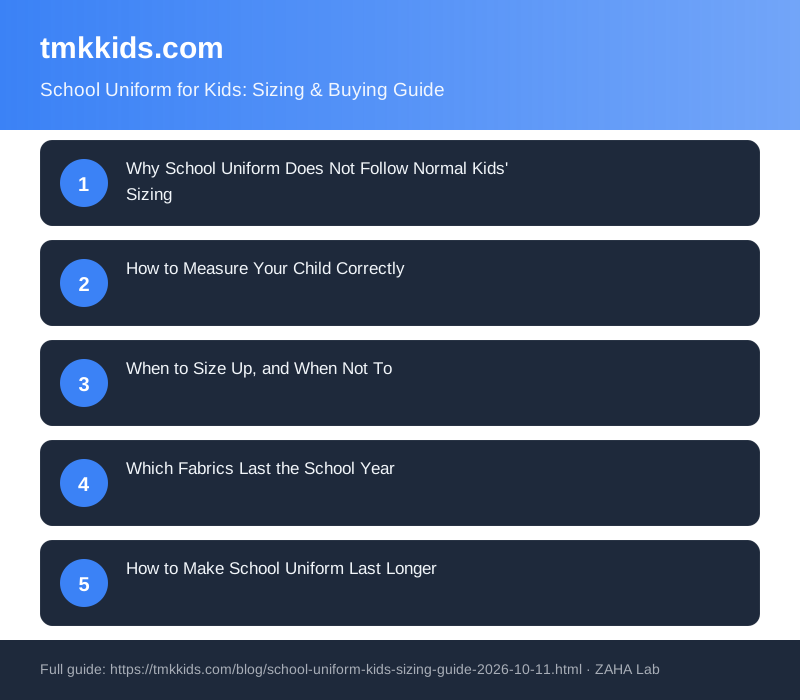
Why School Uniform Does Not Follow Normal Kids' Sizing
Standard children's clothing runs by age. A label reads "5-6 years" and most children that age fit it reasonably well. School uniform is different. Most school wear brands size by height, not age. A child who is 116cm tall might fit a 5-6 years shirt from one brand and a 7-8 years from another, depending on where that brand draws the line for each height bracket.
Growth makes this worse. Children aged 4 to 11 grow an average of 6cm per year. That sounds modest until you realise growth happens in bursts, not steadily. A shirt that fits in September can be pulling across the shoulders by Bonfire Night if your child hits a growth phase over half term. Growth happens in the trunk first, then in the legs. This is precisely why sizing up in tops makes sense, while the inside leg measurement stays the anchor for trousers.
How to Measure Your Child Correctly
You need a soft tape measure and your child standing straight in socks, not shoes. Take all four of these measurements before opening any product page.
- Chest: wrap the tape around the fullest part of the chest, keeping it snug but not tight. Add 5cm to the raw figure for comfort ease when you compare against a size chart.
- Waist: measure around the natural waist, just above the hips. Most school trousers have an internal elastic adjuster, so this matters less than the inside leg, but it is still a useful cross-check.
- Inside leg: from the top of the inner thigh to the ankle bone. This is the single most important measurement for trousers, skirts, and pinafores. Match it precisely.
- Height: stand your child against a wall in socks, mark the top of their head, and measure from the floor. Use this to verify your other measurements against the brand's height chart.
Write all four numbers down. Then open the size guide on the retailer's product page, specifically the height and chest columns, not the age column. Marks & Spencer, Next, and John Lewis all publish detailed size charts for their school wear lines. Use them every time, including for brands you have bought from before, because sizing varies between product lines even from the same manufacturer.
For polo shirts that hold up to daily washing, the Amazon Essentials Boys' Pique Polo Shirt Multipack is a reliable everyday option. The 60% cotton, 40% polyester blend keeps its shape after 60 washes and dries noticeably faster than pure cotton, which matters when you are running a load every other evening during term.
When to Size Up, and When Not To
Size up by one in shirts, polo shirts, and jumpers. A top that is slightly roomy in September will still look presentable by April. One bought to fit exactly in September will be pulling across the shoulders before Christmas.
Do not size up in trousers, skirts, or pinafores. A waistband that is too large slides down, even with an internal adjuster. The inside leg should match your measurement. A trouser that is 4cm too long is a trip hazard for younger children and looks immediately wrong in class photographs. For girls' school pinafores, buy to the actual hip measurement and let the hem sit where it naturally falls.
Girls' school trousers with an adjustable waistband make this much easier to manage. The Amazon Essentials Girls' Straight-Leg Uniform Stretch Trouser comes in half-size height increments, so it is possible to match the inside leg measurement precisely without having to go up a full size in the waist. The stretch fabric also handles a full day of movement without bagging at the knee by lunchtime.
Which Fabrics Last the School Year
Pure 100% cotton looks crisp on the first day of term. By October it has shrunk slightly, creases badly after every wash, and takes an age to dry on a damp autumn evening. A 65% polyester, 35% cotton blend holds its shape better across the school year, dries faster on an airer, and comes out of the machine looking reasonable without ironing if you fold it straight away.
For PE kits, 100% polyester mesh is the standard. It wicks moisture, survives 40-degree washes, and does not shrink. The downside is pilling, which shows clearly on black and navy after 20 or so washes. Buying from a brand that uses combed yarn keeps the surface smoother for longer.
Reinforced knees on school trousers are worth the small premium. Primary-age children spend a lot of time on the floor: carpet time in class, crawling in the playground, kneeling on the grass. Standard fabric wears through at the knee by February. A reinforced-knee version typically costs around 20% more but lasts twice as long in actual use.
How to Make School Uniform Last Longer
Buy two complete sets in September. Rotating between them means each item is washed roughly half as often. A shirt worn five days a week shows significant wear by week 12. Alternated with a second shirt, that same garment can reach week 24 looking presentable.
Iron-on name labels are more reliable than peel-off ones. Peel-off labels detach in a hot wash after three or four cycles. Iron-on labels stay put for the life of the garment and transfer cleanly to a younger sibling's uniform when the item is passed down.
Wash at 40 degrees rather than 60 for everyday school dirt. A 40-degree cycle handles food stains, pen marks, and general grime without stressing the fabric. Reserve 60 degrees for PE kit and anything with grass or mud stains that did not shift at 40.
For PE layers and casual school-day t-shirts, the Fruit of the Loom Kids' Classic T-Shirt 5-Pack keeps the per-unit cost low while giving enough items to rotate through without constant washing. The 100% cotton is soft against the skin for younger children who find polyester scratchy during sport.
Putting It All Together
School uniform shopping is straightforward when you measure first and match against size charts rather than age labels. Size up one in tops, match inside leg exactly in trousers, pick a polyester-cotton blend for durability, and buy at least two complete sets. Do those four things and September's uniform has a realistic chance of still being worn in July.
FAQ
Should I buy school uniform by age or by size?
Always buy by measurement, not age. Compare your child's chest and inside leg figures against the brand's own size chart. Children who are tall or short for their age can be one or two sizes away from what the age label suggests, and buying by age in those cases wastes money.
How many sets of school uniform does my child need?
Two complete sets is the practical minimum: one to wear, one to wash. Three sets is more comfortable in winter when items take longer to dry on an airer indoors. Buying three in September is cheaper than buying one in September and two replacements in January.
What fabric needs the least ironing for school shirts?
A 65% polyester, 35% cotton blend is the most crease-resistant option widely available. Remove it from the machine promptly and fold or hang immediately. Most parents find it goes straight back on the hanger without ironing at all, which matters on a busy school-day morning.
How do I stop school trousers going baggy at the knee?
Look specifically for trousers labelled with a reinforced knee panel. These cost a little more but resist bagging significantly longer. Washing inside-out also helps preserve the outer surface of the fabric over repeated cycles.
When during the school year should I check whether uniform still fits?
Check in January after the Christmas holiday: many children have a noticeable growth spurt over the break. Check again in April before the summer term. The most common items to replace are shirts outgrown across the chest and trousers outgrown in length.