Affiliate disclosure: some links in this article are affiliate links. If you purchase through them, TMK Kids earns a small commission at no extra cost to you.
How to Size Kids' School Uniform Correctly
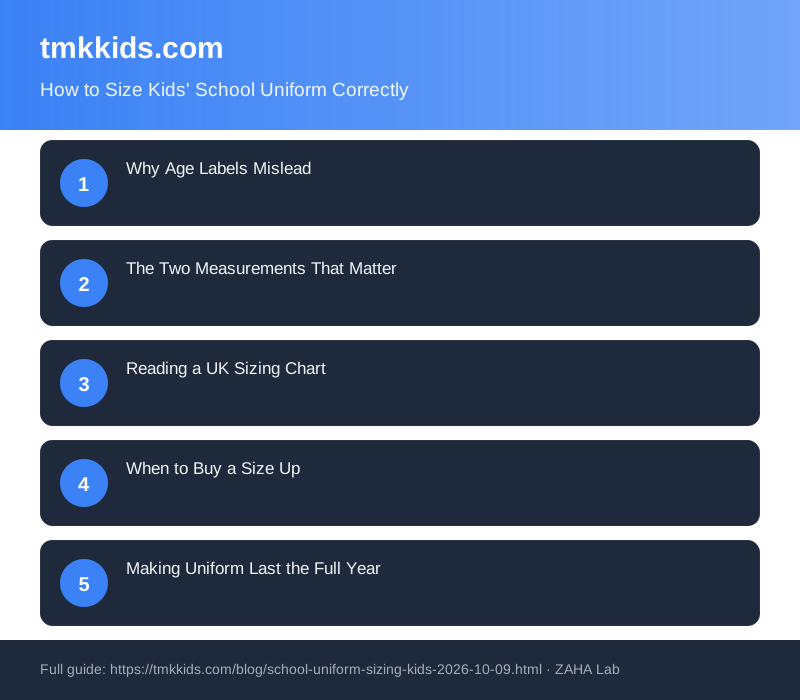
British children grow an average of 6 cm per year between ages 5 and 12. Buy the wrong size in September and the blazer may not see February.
Why Age Labels Mislead
UK children's clothing uses a nominal age range such as "age 5-6", but that range is set to a statistical average. A tall 6-year-old may need age 7-8 tops. A slender 9-year-old can sit comfortably in age 8-9 bottoms. The spread across major retailers is measurable: a "9-10 years" polo shirt from one high-street brand can be 6 cm longer in the body than the same nominal size from another.
There is no mandatory UK sizing standard for children's clothing. Each retailer sets its own template and can revise it between seasons. A size that fitted perfectly from one shop in September 2025 may run differently from the same shop in September 2026. Measuring directly cuts through that variability.
The Two Measurements That Matter
Chest and height are the numbers every UK school wear chart uses. Take both at home before you shop.
Chest: Measure around the fullest part of the chest, under the arms, with the tape snug but not tight. Record the figure to the nearest centimetre. Do not measure over a thick jumper.
Height: Stand the child against a flat wall, bare feet together, head level. Mark the top of the head and measure from the floor to the mark. Do this in the morning. Children can be up to 1 cm shorter by late afternoon due to spinal compression during the day.
For trousers and skirts, also take the inside leg from the crotch to the floor and the natural waist. These two figures vary sharply between children of identical height, and they are worth noting alongside chest and height.
Reading a UK Sizing Chart
Most UK retailers publish a chart with columns for age, chest, and height. When your child's measurements land in different columns (chest suggests 8-9, height suggests 7-8), always choose the larger garment. You can hem a trouser leg or fold a cuff. Unpicking a tight seam on a polo shirt ruins the fabric.
M&S and Next both publish their charts online, updated each season. Bookmark the chart for whichever retailer you use, since fit can shift between collections even within the same brand. It takes two minutes to check and saves a return trip.
When to Buy a Size Up
Buying one size larger than the chart suggests is worth it for tops aimed at children under age 8, who grow fastest through the torso between August and January. The same reasoning applies to trousers with an adjustable elasticated waistband: one extra size costs nothing, and the adjuster takes up the slack until the child grows into the waist measurement.
Buying in July for September? Factor in a summer's worth of growth. The average primary-school child adds 2-3 cm between the end of term and the first day back. A top bought to chart in July may already be snug by week two of term.
One situation where sizing up backfires: structured blazers. A blazer too large in the shoulder looks poor immediately and cannot be easily altered by hand. For fitted outerwear, stick to the chart or try it on in store.
Making Uniform Last the Full Year
School wear takes daily punishment. A few choices at the buying stage extend the life of every item considerably.
Look for reinforced elbows on knitwear and double stitching at the underarm seam on polo shirts. Wash at 40°C rather than 60°C: lower temperatures preserve colour and reduce shrinkage. Avoid tumble-drying cotton polo shirts on high heat. Done on medium heat, they still shrink slightly over time, which is another reason to start slightly larger in pure cotton from day one.
Name labels are non-negotiable. Sew-in labels outlast iron-on versions by several months. A stamp-style fabric marker is the fastest option and holds well through a full term of washes.
The Polo Shirt Question
School polo shirts are the highest-turnover item in most uniform wardrobes. Children go through two or three in a year through staining and everyday wear. Buying in multipacks reduces the per-shirt cost significantly, which matters when you are replacing them mid-year.
The Amazon Essentials Boys' School Uniform Polo Shirts multipack runs slightly slim in the fit, so size up one for broader-shouldered children. For girls, Amazon Essentials Girls' School Uniform Polo Shirts use the same durable pique jersey construction with a slightly longer hem designed to stay tucked.
When buying white polo shirts in volume, read reviews specifically for colour retention. A white top that greys by the sixth wash is a false economy at any price point. Look for reviews from buyers who have washed the shirts at least ten times before writing up.
FAQ
What age should I start measuring my child for school uniform?
From around age 4, before the first school year. Children's proportions vary significantly from that point onwards, and age labels alone produce poor fits. Measure at the start of each school year and keep a written note to track how quickly each child grows between seasons.
How much growing room should I allow in school uniform?
About 2-3 cm in body length for tops and the same in trouser leg length covers most of a full school year for primary-age children. More than that and garments look oversized from the first wear. An adjustable elasticated waistband handles girth differences without needing extra length in the leg.
What does "slim fit" mean on school uniform labels?
Slim fit means the garment is cut narrower in the chest and waist than standard. It suits children with a lean build. If your child sits at or above the 50th percentile for chest-to-height ratio, a standard or "regular" fit will be more comfortable and less likely to pull at the seams after a few months of wear.
Why do school uniform sizes vary so much between shops?
There is no mandatory sizing standard for UK children's clothing. Each retailer sets its own template, and the nominal age range is a guide, not a specification. Measuring your child and matching those numbers to the individual retailer's chart produces reliably better results than ordering "the usual size".
Can I buy school uniform online without trying it on?
Yes, provided you have the two key measurements. Check the returns policy before ordering. Most major UK retailers offer free returns. For a new brand, order two adjacent sizes, try both on the child, and return the one that fits less well. After that first purchase you will know the brand's fit and can order directly next time.