Kids School Uniform Guide: Fit, Value & Quality 2026
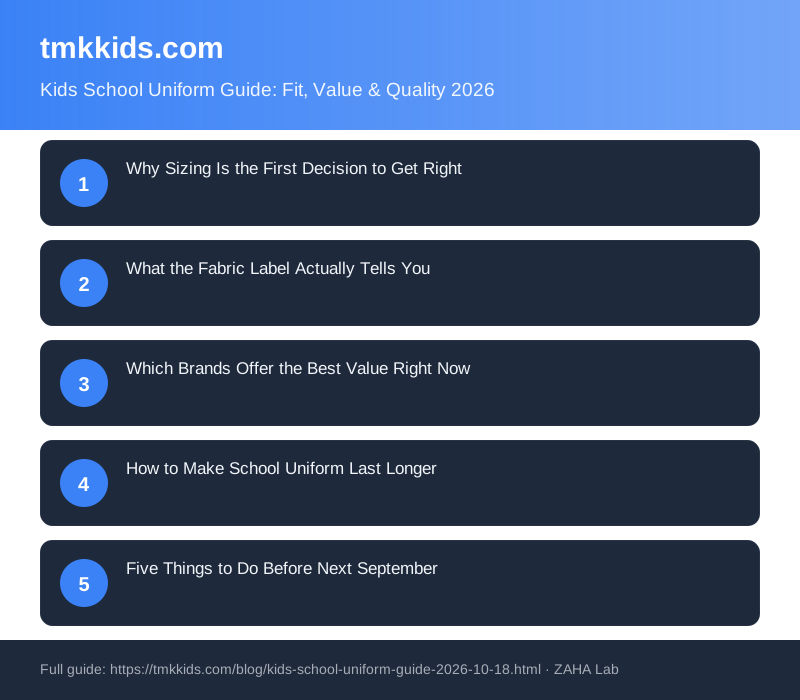
The average UK family replaces at least one piece of school uniform before the Easter holidays, spending an extra £30 to £50 per child they did not budget for. The cause is almost never poor quality. It is getting sizing and fabric wrong at the very start.
Why Sizing Is the First Decision to Get Right
Children between ages 5 and 11 grow around 5 to 6 cm per year on average. Buy uniform to fit perfectly in September and it will be visibly too small by February. Buying two sizes up solves one problem and creates another: the child looks swamped and shoulders pull badly on polo shirts. One size up is the answer in almost every case.
For polo shirts and jumpers, a single size up leaves roughly 3 cm of room at the shoulder seam without looking oversized. For trousers, the adjustable waistband changes everything. Most supermarket and high-street school trousers include an internal elastic adjuster that draws in up to 5 cm at the waist. Use it at the start of the year, then release it as the child grows. A trouser that fits at the waist but has an extra 4 cm of leg length can simply be turned up, then let down later.
Age labels on children's clothing are a rough guide only. A seven-year-old wearing age 8-9 trousers is not unusual. Check the actual centimetre chest and waist measurements printed on the label against your child's measurements, then add 2 to 3 cm. That number is the size to buy.
What the Fabric Label Actually Tells You
School uniform takes a hard beating. It picks up mud and paint by Tuesday morning and needs to survive five washes a week across 38 school weeks. That works out at approximately 190 machine washes per academic year.
Pure cotton feels soft and breathes well, but creases badly and shrinks at the shoulder after repeated hot washes. Pure polyester does not shrink, but it traps heat and moisture, which means uncomfortable children and persistent complaints. The practical middle ground for school wear is a 65% cotton, 35% polyester blend. It breathes adequately, holds its shape, and survives 40°C machine cycles without pilling.
On trousers, run a finger across the knee area before you buy. A well-made pair will have a visibly denser weave or a second layer of fabric at the knee. This reinforcement is not a marketing claim. Without it, the knee will thin through by January on most active five- to eight-year-olds.
On polo shirts, double stitching at the shoulder seam is the detail that separates a shirt that survives from one that splits by half-term. A single-stitched seam on a £3 polo fails at the shoulder consistently. Spending £6 to £8 on a twin-pack with a double-stitched collar will see most children through to July without a replacement. The Amazon Essentials Boys' School Polo Shirts 5-Pack uses a 65/35 blend with a double-stitched collar and consistently receives strong reviews from UK parents across all age ranges from 3 to 15.
Which Brands Offer the Best Value Right Now
The answer depends on what your school specifies. If the school requires a particular badge, crest colour, or named supplier, you will need to buy from their appointed uniform shop. For generic school wear worn across most primary and secondary schools, a few options stand out.
Supermarket own-brand. George at Asda, Sainsbury's Tu, and F&F at Tesco all manufacture school wear in a 65/35 blend at £3 to £7 per item. Polo shirts and trousers from these ranges perform well. Their jumpers and sweatshirts can start to pill after around 20 washes, which is an acceptable trade-off at that price point if you are buying for a younger child who will outgrow the garment before it wears out anyway.
Amazon Essentials. The school uniform range from Amazon Essentials is made to a consistent specification and carries a large number of verified UK buyer reviews. For girls, the Amazon Essentials Girls' School Uniform Pleated Skirt 2-Pack is a dependable buy for ages 4 to 12. The adjustable waistband works reliably, and the polyester-viscose blend holds its pleat through regular washing better than cheaper alternatives at the same price.
Marks & Spencer. Polo shirts start at around £9 each, which is noticeably more than the supermarket equivalent. The difference in stitching quality and fabric density is real. For children who are particularly hard on clothes, the M&S garment often works out cheaper than replacing a budget item twice in the same year.
For t-shirts worn under a jumper or on non-uniform days, the Fruit of the Loom Kids' Valueweight T-Shirts 5-Pack is a longstanding value pick. They are made from 165 g/m² cotton, wash well at 40°C, and five t-shirts for under £15 is hard to match from a UK high street.
How to Make School Uniform Last Longer
Washing inside out does two things: it prevents surface pilling on the outside of the fabric, and it keeps colours noticeably darker for longer. 40°C is the right temperature for a 65/35 blend. 60°C sanitises effectively but it accelerates shrinkage at the shoulder and weakens seams over repeated cycles. Reserve 60°C for genuinely soiled items, not routine daily washing.
Air drying beats the tumble dryer for extending garment life. Tumble drying at high heat shrinks the cotton component and degrades the elastic in adjustable waistbands significantly. If the dryer is unavoidable, the low-heat setting makes a measurable difference over a full school year of use.
Iron polo shirts while still slightly damp. A bone-dry shirt needs more heat to press flat, and repeated high-temperature ironing yellows white fabric noticeably by the second term. A cool-warm iron on a damp shirt takes 30 seconds and produces a better result.
Name labels return jumpers from lost property. An unmarked jumper stays lost. Iron-on name labels from a 30-pack cost around £5 and last the full year on most school fabrics. That £5 is significantly cheaper than a replacement £15 sweatshirt in January.
Five Things to Do Before Next September
- Measure your child in late July, not early September when popular sizes sell out at every retailer.
- Buy two or three polo shirts in the next size up alongside the currently fitting size.
- Take in adjustable waistbands on all trousers to fit before the first week of term.
- Apply name labels to every item before day one.
- Keep one spare pair of trousers unworn in a drawer as a mid-year backup for the inevitable growth spurt.
FAQ
How often should I replace kids' school uniform?
For most children aged 5 to 11, one full set of uniform bought at the start of the academic year should last through to the following summer. If you size up by one and choose a quality 65/35 cotton-poly blend, mid-year replacement is rarely necessary except after a significant growth spurt in children aged 9 and above.
What is the best fabric for school polo shirts?
A 65% cotton, 35% polyester blend is the most practical choice for daily school wear. It breathes better than pure polyester, creases far less than pure cotton, and holds its shape through regular 40°C machine washes without significant shrinkage or pilling.
How do I stop white school uniform turning grey?
Wash white school items separately from any coloured clothing and use a non-biological powder at 40°C. Adding a scoop of an oxy-based whitener such as Vanish Oxi Action to the drum every two or three washes keeps whites noticeably brighter without damaging the fabric weave over time.
Is it worth spending more on school uniform?
It depends on the garment type. Trousers and polo shirts from mid-range brands like M&S last measurably longer than the cheapest supermarket versions. For items such as PE kits, book bags, and plimsolls, own-brand supermarket versions typically perform just as well as premium alternatives at half the price.
Can I tumble dry school uniform?
Yes, but only on a low-heat setting. High-heat tumble drying shrinks the cotton in blended fabrics, degrades waistband elastic, and accelerates seam failure. Air drying is the better option for keeping school clothes wearable through a full academic year.